Pweave - Scientific Reports Using Python
Pweave is a scientific report generator and a literate programming tool for Python. Pweave can capture the results and plots from data analysis and works well with NumPy, SciPy and matplotlib. It is able to run python code from source document and include the results and capture matplotlib plots in the output.
Note
Pweave 0.30 has been updated to use IPython to run code from the documents. This brings support for IPython magics and rich output and support for other.
Features:
- Python 3.4, 3.5 and 3.6 compatibility
- Execute python code in the chunks and capture input and output to a report.
- Rich output and support for IPython magics
- Use hidden code chunks, i.e. code is executed, but not printed in the output file.
- Capture matplotlib graphics.
- Evaluate inline code in documentation chunks marked using
<% %>and<%= %>. - Cache all code and results from previous runs for fast report generation when you are only working with documentation. Inline code will be hidden in documentation mode.
- Publish reports from Python scipts. Similar to R markdown.
- Run from command line or interpreter.
- Execute code using any Jupyter kernel.
- Pweave 0.30 works on Python 3 only, but you can use Python 2 run the code via kernel argument.
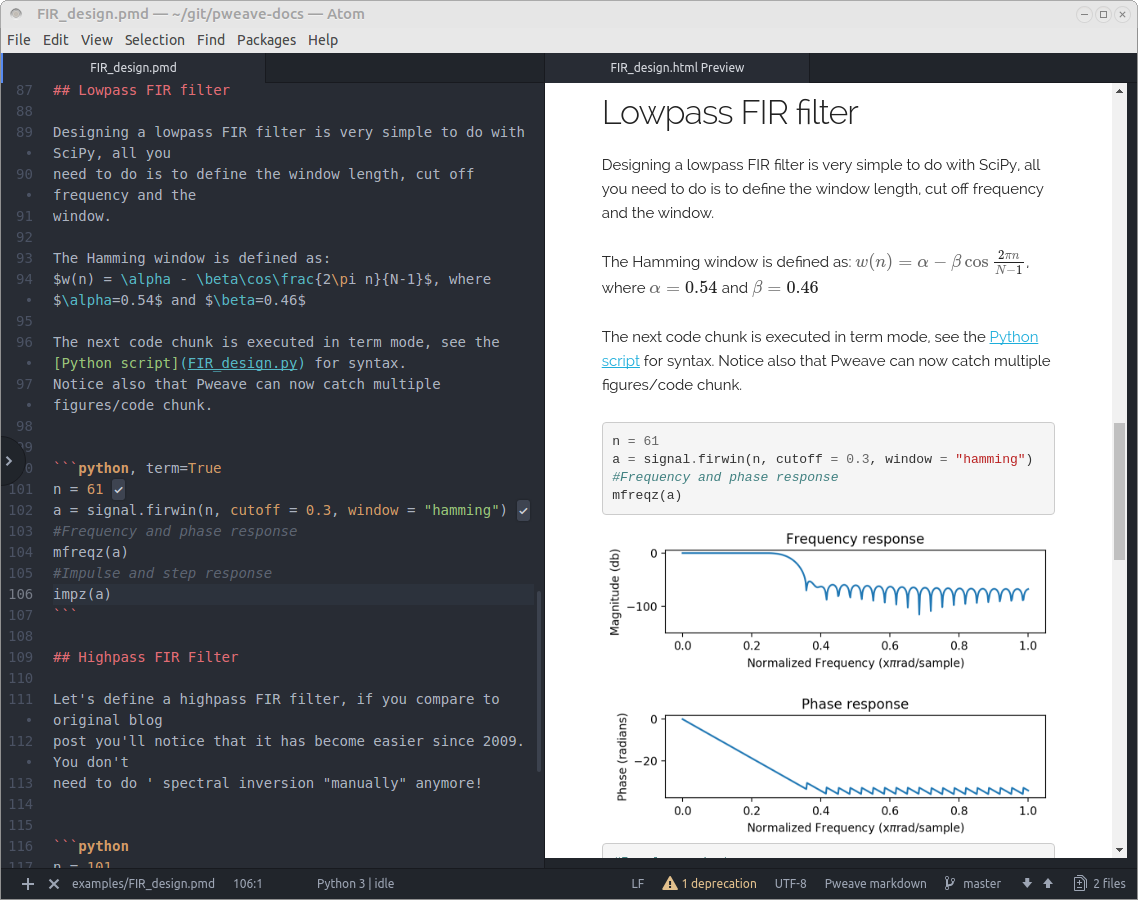
Pweave markdown document in Atom together with output. Atom support using language-weave-package.
Install and quickstart:
with pip:
pip install --upgrade Pweave
with conda:
conda install pweave -c conda-forge
After the installation you get options with:
$ pweave --help
$ ptangle
Documentation
Browse documentation or go straight to an examples
Thanks
Pweave was originally inspired by Sweave, an excellent tool for R programmers. The current version has also been influenced by ideas from knitr and R markdown.
Thanks to following people for contributing patches and ideas: Jakub Kowalski, Tamas Nepusz, Nicky van Foreest, Mark Edgington, Thomas Unterthiner, Matthew McDonald, Grant Goodyear, Aaron O’Leary, Thomas Saunders and contributors on Github https://github.com/mpastell/Pweave/graphs/contributors.